
Helping
patients and
families stay
in touch
When a loved one is
undergoing medical
treatment, keeping family
and friends informed
can be a challenge. Saint
Agnes is proud to sponsor
CaringBridge – a free not-
for-profit Internet service
created to keep friends and
family connected during
significant life events.
Families – like the Bristols –
have turned to CaringBridge
to post journal entries and
photographs and send and
receive messages. During
Scott Bristol’s hospital
stay, hundreds of family
members and friends used
CaringBridge to find updates
on his progress and send
messages of support.
Setting up your own
secure, personalized page
takes just minutes. The
CaringBridge community
includes families in all
50states and many countries
worldwide.
6
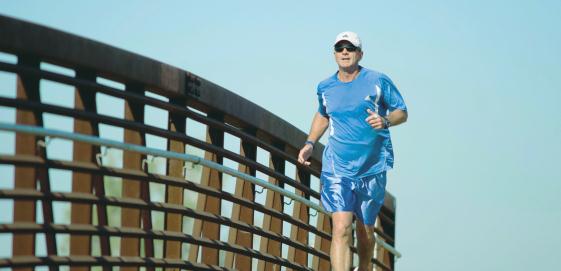
Twenty minutes into what started as a
typical afternoon jog for 60-year-old
Scott Bristol, the unthinkable hap-
pened. The avid runner, who was
used to tallying a list of 3- to 6-mile
runs every week, collapsed, experi-
encing a massive heart attack that
resulted in sudden cardiac arrest.
Fortunately, construction workers
nearby witnessed Scott’s fall, started
chest compressions and called 9-1-1.
Within minutes, he was taken by
ambulance to Saint Agnes Medical
Center, where a team of specialists in-
serted a stent into his blocked artery
to restore blood flow. Having gone
nearly eight minutes without oxygen,
it was unclear how his brain had been
affected.
Luckily for Scott, just days before
his heart attack, Saint Agnes had
become one of several top hospitals
from around the world to offer a life-
saving treatment option called thera-
peutic hypothermia (TH) – a cooling
therapy that chills a patient’s body
to the point of hypothermia. Though
the concept may sound strange, the
treatment gives cardiac arrest patients
like Scott a greater chance of survival.
A FIGHTING CHANCE
Studies show that of the roughly
300,000 Americans who experience
cardiac arrest outside of a hospital
each year, fewer than 10 percent sur-
vive. For those who do, the chance
of returning to normal brain function
is questionable. But evidence shows
that TH can greatly improve these
odds.
“Research shows that certain types
of cardiac arrest patients who are
treated with TH are twice as likely to
be neurologically normal or near nor-
mal and are less likely to die following
cardiac arrest,” says G. Michael Saul,
MD, a physician lead for TH at Saint
Agnes.
Endorsed by the American Heart
Association, TH works by protecting
the brain and other vital organs. It low-
ers oxygen requirements, decreases
swelling and limits the release of
toxins that can cause cells to die. Cli-
nicians use ice packs, cooling blankets
and chilled intravenous fluids to lower
the patient’s body temperature to
32°C¦to 34°C for 24¦hours. During this
time, the patient is kept in a drug-in-
duced coma and carefully monitored
in the critical care unit. The patient is
then gradually rewarmed and usually
wakes within 72 hours.
A REAWAKENING
Just seven days after his brush with
death, Scott woke to see family sur-
rounding his hospital bed. The next
day, he was walking the hospital halls,
and three days later, he returned
home.
Bit by bit, Scott has regained his
memory and strength. Just a few
months after returning home, he is
back to many of his favorite activi-
ties: biking, tennis, kayaking and, of
course, running.
“We are so blessed that Saint
Agnes had the foresight to bring this
treatment here,” Scott says.
HEALTHY
YOU
For more information
or to see a sample of a
CaringBridge web page, visit
www.samc.com/caring-bridge.
“We are
so blessed
that Saint
Agnes had
the foresight
to bring this
treatment
here.”
– Scott Bristol
Cool recoveries
New chilling treatment protects patients
www.samc.com