Basic HTML Version


health
link
5
Meet our robotic
surgeons
CARDIOTHORACIC SURGERY
J. W. Randolph Bolton, MD
Shamsuddin Khwaja, MD
GYNECOLOGICAL SURGERY
Kelli Beingesser, MD
Cynthia Bergmann, MD
Lisa Golik, MD
Seung-Nam Kim, MD
Christine Lopopolo, MD
Stewart Mason, MD
Marshall Noel, MD
Paul Ostoya, MD
John Swanson, MD
UROLOGICAL SURGERY
Yuk-Yuen Leung, MD
Thomas Minor, MD
Nadeem Rahman, MD
COLORECTAL SURGERY
William Carveth, MD
Wai Lee, MD
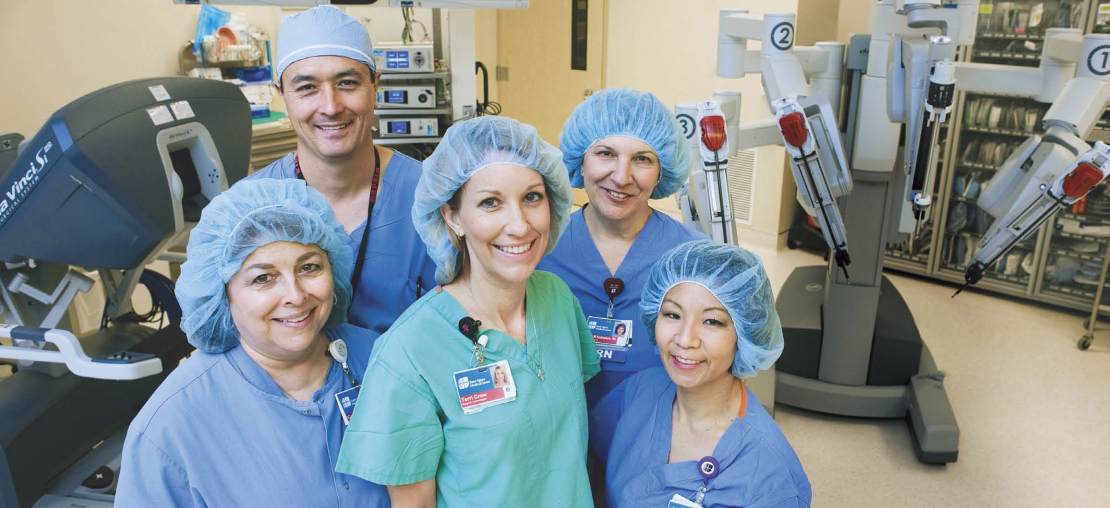
Some members of Saint Agnes
Medical Center’s comprehensive
robotics program (back row, left to
right): Kevin Rigg, ST, and Janice An-
dreasen, RN; (front row, left to right)
Carol Wacker, RN; Terri Crow, ST; and
Janine Nakazawa, RN.
Find out more!
For more information
about robotic surgery, visit
www.samc.com/da-vinci-robotic-surgery
or call
559-450-2000
.
DA
VINCI SURGERY
Saint Agnes leads robotics revolution
In medical matters, bigger isn’t always
better. From pills to needles to scars,
we’ll take the smallest we can get.
That’s also true of surgical incisions.
And the very smallest of these are likely
to be made when a doctor uses the
da Vinci
®
Robotic Surgical System –
among the latest in robotic-assisted
minimally invasive surgery.
Saint Agnes Medical Center is
proud to offer more robotic special-
ties than any other hospital in the San
Joaquin Valley. And when it comes to
experience, Saint Agnes once again
stands out from the rest. Having been
the first to introduce robotic surgery
to the Central Valley in 2001, Saint
Agnes made headlines soon after as
the first hospital on the West Coast
to use robotics during a minimally
invasive coronary bypass.
Since then, robotic technology has
evolved significantly. Dedicated to re-
maining at the forefront of minimally
invasive technology, Saint Agnes pur-
chased its second robot in 2010 – the
da Vinci Si
®
. Considered the world’s
most advanced robotic system, the
Si offers several upgraded features,
which help to further perfect the
physician’s surgical capabilities. And
further demonstrating Saint Agnes’
well-established robotics program,
more than 900 cases have been
performed at the Medical Center dur-
ing the past two years alone.
“For patients, the potential benefits
with using the da Vinci are well worth
it,” says gynecologist Cynthia Berg-
mann, MD. “Patients can expect less
pain, scarring and blood loss; a faster
recovery; and lower risk of infections.”
HOW IT WORKS
Like a conductor leading a symphony,
the surgeon orchestrates every move
the robot makes from a console a
few feet away from the surgical table.
It operates like an extension of the
surgeon’s own highly skilled hands,
translating hand and wrist movements
to microinstruments inserted into the
patient’s body.
“The da Vinci’s microinstruments
and the optical magnification actually
allow me a level of precision that just
isn’t possible with open surgery,”
Dr. Bergmann says.
Looking through a video monitor-
ing system – like a pair of binoculars –
the surgeon gets a 3-D, high-defini-
tion view inside the patient’s body,
with magnification up to 10 times the
vision of the naked eye.
A QUICKER RECOVERY
For triathlete Leann Martinusen, hav-
ing robotic surgery was a no-brainer.
In spring 2011, Leann underwent
a robotic myomectomy – surgery
to remove uterine fibroids – her
second procedure in three years.
Leann’s first traditional myomectomy
in 2009 – when robotic surgery was
not an option – required nearly four
weeks of healing.
“Walking to and from the mailbox
was about as much as I could do
during the first few days,” Leann
says. But after her latest robotic
myomectomy, Leann was back to
walking a couple of miles within a
few days.
“It’s a miracle of modern science,”
Leann says. “Being able to be pretty
active within a day or two of surgery
was amazing.”
TYPES OF SURGERY
The da Vinci system can be used
for a variety of operations, from
minor to major procedures.
Saint Agnes’ robotic surgery
program includes treatments for:
•
Bladder cancer
•
Colorectal
cancer
•
Coronary artery disease
•
Endometriosis
•
Gynecologic
cancer
•
Heavy uterine bleeding
•
Kidney cancer
•
Kidney disorders
•
Lung cancer
•
Prostate cancer
•
Uterine fibroids
•
Uterine
prolapse
Summer 2012