Basic HTML Version









health
link
6
quick and painless, often done as a
radiology clinic visit. “Clinicians will
use an ultrasound to better view the
abdominal aorta,” says Dr. Copeland,
“and then they measure to assess
whether there is a swelling.”
FOR WOMEN
Breast cancer.
Aside from skin cancer,
breast cancer is the most common
cancer among women in the United
States, says the American Cancer
Society (ACS). “Statistics show that
survival rates have been on the rise
thanks to greater awareness, earlier
detection and better treatment op-
tions,” says Dr. Copeland.
The ACS recommends that women
follow these screening guidelines:
•
Women in their 20s and 30s need
clinical breast exams about every
three years. Women 40 and older
should have one every year.
•
Women should have annual
mammograms starting at age 40
and continuing for as long as they
are in good health.
•
It’s important for women to know
how their breasts normally look and
feel. Tell your doctor if you notice
changes. Starting breast self-exams
is an option for women starting in
their 20s.
•
Depending on personal risk factors,
more frequent screenings may be
recommended.
Cervical cancer.
A Pap test should be
part of a woman’s routine preventive
screenings starting at age 21, advises
the American College of Obstetricians
and Gynecologists. Most women
should follow these guidelines:
•
Ages 21 to 29: Have a Pap test
every two years.
HEALTH
SCREENINGS
Take charge of your health
Continued from front page
•
Ages 30 to 64: Talk to your doctor
about frequency. You may need a
Pap test only every three years if
you’ve had normal test results at
least three years in a row.
•
Age 65 or older: Talk to your doctor
about whether to continue testing.
If you’ve had at least three normal
Pap tests and no abnormal ones in
the last 10 years, you may be able
to stop testing.
Osteoporosis.
Women are four times
more likely than men to get osteopo-
rosis, says the National Osteoporosis
Foundation. But most of the time,
there are no signs it is developing.
Your doctor can determine your bone
health with a bone mineral density
test. “If you’re at risk for osteoporosis
or if tests determine that you have
the disease, your physician will usually
suggest a diet with good levels
of vitamin D and calcium,” says
Dr. Copeland. “It’s also important to
add certain exercises to your routine,
especially weight-bearing exercises.”
FOR BOTH MEN AND WOMEN
Dr. Copeland suggests regular
screenings for these four common
conditions in both men and women.
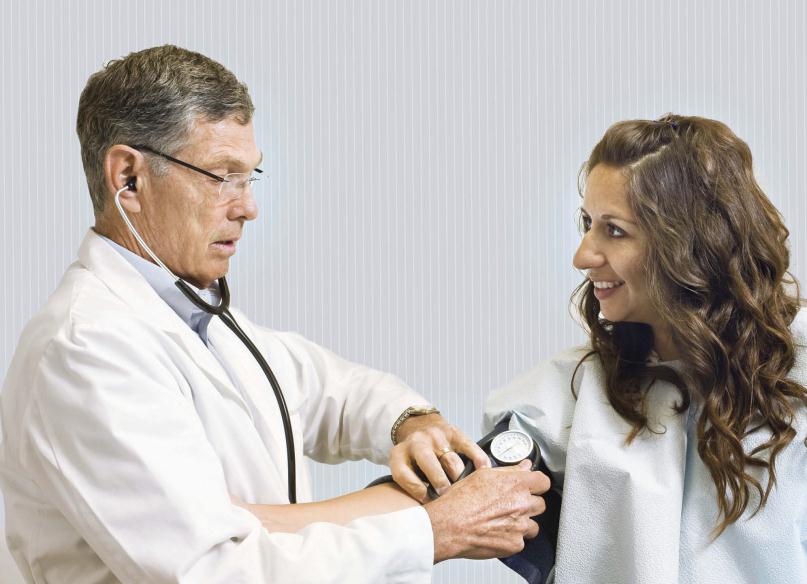
High blood pressure.
Stroke. Heart
attack. Kidney problems. Those are
just some of the potentially deadly
diseases triggered by high blood
pressure. But it often has no symp-
toms. That’s why it’s important to get
it checked at least every two years.
If you have high blood pressure,
you may need medication to con-
trol it. For most people, high blood
pressure is 140/90 mm Hg or higher.
High-normal blood pressure – also
called prehypertension – falls be-
tween 130/85 and 140/90 mm Hg.
Diabetes.
You should be screened
for diabetes if your blood pressure
is higher than 130/85 mm Hg or you
take medication for high blood pres-
sure. A blood test can detect if your
blood sugar level is too high.
High cholesterol.
The trouble with
having too much cholesterol in your
blood is that it can clog blood vessels
and lead to a heart attack or stroke.
You should have a fasting cholesterol
test every five years starting at age 20.
You may need to be tested more
often if:
•
Your total cholesterol is 200 mg/dL
of blood or higher.
•
Your HDL (good) cholesterol is less
than 40 mg/dL.
•
You are a man over age 45 or a
woman over 50.
•
You have other risk factors for heart
disease and stroke, such as high
blood pressure.
Colorectal cancer.
Screening for
colorectal cancer can find abnormal
growths in the colon before they
become cancerous, and it can detect
signs of the disease before they
cause symptoms. You should get
tested for colorectal cancer once
you reach age 50. And if you have a
family history of colorectal cancer,
you may need to start screening
earlier. Your doctor can tell you which
screening test for this disease is best
for you.
“If you have a health concern,
regardless if it’s covered here or not,
be sure to speak to your doctor,”
Dr. Copeland says.
Save time for
key screenings
Who couldn’t use a little more time? That’s why Saint Agnes Breast Center is
able to combine two important screenings for women – your mammogram
and bone density scan – into one visit.
Saint Agnes Breast Center is proud to offer the most advanced digital tech-
nology for detecting breast cancer, along with state-of-the-art bone density
scanning, to detect breast cancer or bone thinning at their earliest stages.
To schedule an appointment at Saint Agnes Breast Center, call
559-450-5656
.
www.samc.com