Basic HTML Version












Few people think a small wound or
cut could lead to something more
serious. That’s how Rodger Watson’s
story began. But for those – like
Rodger – who have diabetes, what
starts as a minor foot problem can turn
into a more serious one. In Rodger’s
case, he was fighting to save his leg.
DANGERS OF DIABETES
It was five years ago that Rodger
first developed an infection in his
left foot. Despite persistent medical
treatments, his wound only worsened,
leading to a partial foot amputation.
Rodger is not alone. If this year is
typical, more than 65,000 people with
diabetes will have a lower limb am-
putated, says the American Podiatric
Medical Association.
A key reason is that high blood
sugar levels can reduce blood flow
to the legs and feet, making it hard
for even a small cut or blister to heal.
Nerve damage – a common compli-
cation of diabetes – heightens the
risk of a dangerous infection. With
damaged nerves, people with diabe-
tes might not feel pain, heat or cold
in their feet. They might not realize
Breathing new life
into medical care
1303 E. Herndon Ave.
Fresno, CA 93720
Nonprofit Org.
U.S. Postage
PAID
Saint Agnes
Medical Center
Recycle me! Share this mailer with others and recycle when finished.
CHECK THIS OUT!
Saint Agnes Wound,
Ostomy and Hyperbaric
Center is one of a few
centers of its kind in the
Central Valley. For more
information, please call
559-450-3456
or visit
www.samc.com/
wound-ostomy-and
-hyperbaric-center.
Xxxx
Xxxx
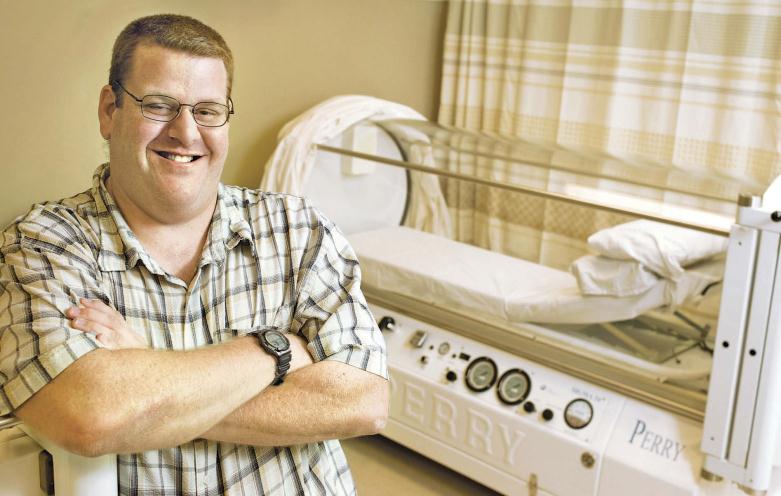
Rodger Watson is all smiles
after successfully completing
hyperbaric oxygen therapy.
when a sore becomes infected and
grows worse.
For Rodger, new foot wounds con-
tinued to emerge in the years follow-
ing his foot amputation. Specialists
tried antibiotics and foot dressings –
but to little avail. He was left with
two choices.
“Hyperbaric oxygen therapy was
my best and last option,” he says. “If
I didn’t do it, I would have needed to
amputate just below my knee.”
HEALING FROM THE INSIDE
Rodger’s physician referred him to the
Saint Agnes Wound, Ostomy and Hy-
perbaric Center for a series of inten-
sive treatments. “Hyperbaric oxygen
therapy is a painless and simple way
of boosting the supply of oxygen to
the body,” says vascular surgeon Leo
Fong, MD, medical director of the
center. “It helps heal conditions that
aren’t responsive to other types of
treatment.”
The hyperbaric chamber allows
patients to breathe pure oxygen while
the chamber is pressurized at up to
three times the normal atmospheric
pressure.
“This stimulates healing by pro-
moting new blood vessel growth,
boosting oxygen supply to the body’s
tissue, reducing swelling, and it helps
fight infections,” says Dr. Fong.
Rodger’s treatments included
four months of sessions, five days a
week. Within the first week, he no-
ticed his wounds beginning to heal.
“I was really happy because this
meant hyperbarics was going to save
my leg,” he says.
With treatments now finished,
Rodger is expecting to be fitted with
new prosthetics within just a few weeks.
“It feels so good to know that I will
finally get out of this wheelchair and
that I don’t need another amputa-
tion,” he says.
Seems like everyone has a Saint
Agnes story. Read Meegan and
Glenna’s on page 3. Then tell
us yours at www.facebook.com/
SaintAgnesMedicalCenter.
Glenna was born. We had planned
on a natural childbirth, but after
36 hours of labor an emergency
C-section was necessary.
Things were pretty touch-and-go.
In fact, I’m convinced if it weren’t
for the unbelievable attention and
support I received from my doctors
and nurses, we might not be here
to tell the story.
Today, Glenna’s 8 years old, and
we’re both as happy and healthy
as can be, thanks to Saint Agnes.
Fresno, California
What’s your Saint Agnes story?
Share it at Facebook.com/
SaintAgnesMedicalCenter.
What’s
your
story?
Follow us on